.

The Junk Rig community features a wide range of boats, rigs and ideas. We like to showcase one boat on a regular basis and are interested in hearing from any members who would be prepared to share some photos and details of their pride and joy.
Dec 2016 – Tao Zou and Glen Maxwell
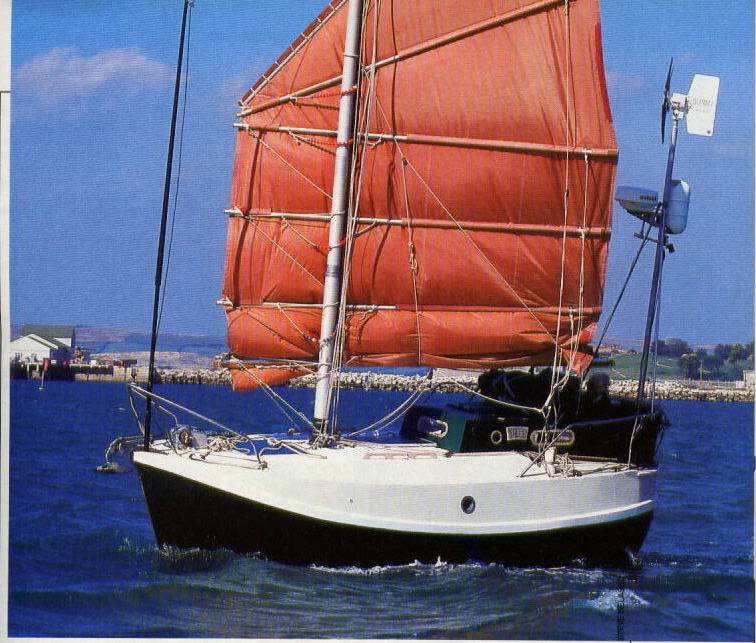
I bought Tao Zou, formally Lanamente, sight unseen, in November of 2015, from JRA member John Liddard, specifically for the Jester Challenges, based on the reputation of the Kingfisher series of junk-rigged yachts. I have not been disappointed. Between December 2015 and March 2016, I prepared her for the May 15 start of the Jester Azores Challenge. From the 1st April through the 10th May, my wife, Nancy, and I sea trialed her from Southampton to the Helford river and back to Plymouth for the start. Some annoying leaks, when the boat was driven hard to windward in winds of F4 and above, were all that showed up.
 One of the first boats across the start line, I was quickly overtaken by most of the fleet as I settled into a slog to windward. Within three days, fully half of the 24 starters had abandoned the Challenge due to deplorable weather. Tao Zou and I plodded on with the expectation that things would improve … they did not! The little boat took everything that was thrown at her and just kept on going. The seas were horrendous at times and many completely washed over her, but she would shake herself off and get going again. I arrived in Praia on 4th June as the sixth to finish, under the bottom four panels of sail, having lost the top three in the four full gales we encountered en route. Four other Challengers followed me in, one of which was the Challenge’s inspiration: Jester skippered by Trevor Leek.


I hauled Tao Zou out on the third day in Praia, to check her over and try to seal the hull to deck join, which let in an annoying amount of water, keeping the cabin sole forever wet. I never once feared for my safety or was anxious about Tao Zou’s integrity, because she is so confidence inspiring. All I can say is that the junk-rigged Kingfisher 26 is one hell of a tough little boat.
Galway Bay, where David Whitehead lives, is made up of about 1,000 sq NM of water with 250 miles of shoreline – a perfect cruising ground for a small boat. Due to the 16ft tidal range, many of the harbours dry out, so shoal draught is essential for successful “Creek Crawling”.
 David’s ideal boat needed to dry out upright and be easy to trail. Camping accommodation in a cuddy would be complemented by occasional nights at a B & B. He chose Carl Stambaugh’s Catbird 16 design. The sharpie hull provides maximum volume and is easy to load onto a trailer, while maintaining a low centre of gravity. Some modifications were made for the sake of better accommodation and easier handling in shoal water. Careful use of ballast, buoyancy and watertight compartments have made for a very seaworthy craft. The all-up weight of the boat is about 350 kg, which allows the use of a lightweight, single-axle road trailer, easily towed by a small car. The boat was built by Tiernan Roe of Ballydehob and named Goblin after Jim Brading’s boat in Arthur Ransome’s We Didn’t Mean to Go to Sea.
The rig is simple, with a flat-cut sail, 25mm diameter bamboo battens and a 50mm bamboo boom. The old gaff was cut down for the yard. Although, like many newcomers to junk, David was concerned about the weight of the junk rig and replaced the solid mast with a hollow spar, the new rig turned out to be a few kilos lighter than the original.
The 9 sq m sail is rigged with a yard hauling parrel, batten parrels and a standing luff parrel on the bottom batten. The battens, nearly parallel to the foot, have a very slight fan and stack neatly when the halyard is eased. All the running rigging is of pre-stretched polyester braid.In light winds, Goblin tacks through about 100° and while the mizzen is used to balance the boat she still needs care tacking. However, she sails well once the wind increases and off the wind the boat really picks up her skirts. The new rig is a great success – once it’s set up.
Oct 2016 – Jester
Jester must, at one time, have been one of the most easily recognised yachts in the world with her full enclosure and the junk rig set on an unstayed mast. The 25ft Folkboat hull was of wood, but of carvel rather than the more usual clinker build. The boat was handled from the central control hatch, which was fitted with a rotatable, canvas dodger (pram hood), so that the crew could keep a proper lookout with his face in the open, but protected from rain and spray. The interior could also be accessed via two side hatches which could be removed when conditions permitted. The boat was steered manually by means of a vertical whipstaff instead of a tiller or, at sea, by the wind-vane which could be adjusted from the control hatch. The lines for handling the rig – halyard, sheet, downhauls and so on – were all within reach of the control hatch. There was normally no reason for the crew to go on deck at sea. Jester had no engine but a 13ft sweep was stowed on deck, which was useful at times. The original Jester was designed (conceived is perhaps a better word) by Blondie Hasler and was built by Harry Feltham in Portsmouth in 1953.

Pic of Mike Richey sailing Jester in later years
When Blondie Hasler sold Jester to Michael Richey in 1964, he could not have found a more suitable candidate to take the helm.
Mike purchased Jester when the boat got back from the second Singlehanded Transatlantic Race, by which time she had completed four transatlantic passages and a patrol of Loch Ness in search of the monster. Mike's first voyage was to the Azores and back and in 1968 he took her in the Singlehanded Transatlantic Race (where they were placed last; however less than than half the fleet got there at all). From the beginning, Jester seemed work of genius, so effortless was sailing her in almost every condition. In the twenty-four years Michael owned her, he made ten transatlantic passages as well as a number of other ocean voyages, including five to the Azores and back. The boat’s fastest east-to-west crossing was with Blondie in 1964 in the remarkable time of 38 days; her longest, 59 days in 1972. The fastest west-to-east crossing was 30 days from Bermuda to the Lizard in 1981, an eventful voyage that encompassed an attack by orca off the Grand Banks, and a knock-down with the loss of the self-steering gear in the Western Approaches.

In 1986, returning from Nova Scotia, the boat was overtaken by a storm of extraordinary ferocity some 300 miles west of Ushant, successively knocked down and finally rolled over and dismasted. She continued the passage on the deck of a banana carrier and had the considerable damage made good by Alec Blagdon's yard over the winter.

The following OSTAR (to use the old name) was, alas, to be Jester’s last. On 15 July 1988, some 500 miles south-east of Halifax, Nova Scotia the boat was abandoned and the skipper taken off by M.V. Nilam, a 60,000-ton bulk carrier bound for New York. A rogue wave had smashed in the superstructure leaving the boat open to the seas. The boat was finally lost under tow. For Mike it was an occasion of immeasurable sadness which he found great difficulty getting over. The boat had not been insured and he was in no position to replace her. (However, in due course, the Jester Trust was founded, and a cold-moulded replica was built. This boat is still going strong.)
For the full and in-depth history, please read the following;
1. http://www.jesterinfo.org/jester.html
2. Members will also find more information in Magazine no 62.
For those who haven't read about these life-inspiring personalities, please take the time to read about Blondie Hasler and Mike Richey
Sep 2016 - Henry Pigott Glory IIAround the world in a 19.5 footer
Henry Pigott started his sailing career as a Royal Marine DUKW driver. These amphibious craft so impressed him that after the war he bought one, used it as a land vehicle then took it to Sweden. DUKWs were such a novelty in this neutral country that he got a very good price for it. This enabled him to buy an extremely elegant Dragon-like, 22 square metre - his first boat to be called Glory. After being held by the Russians for a while he sailed her home. Several more adventures followed in various craft, until he crossed the Atlantic in a 18.9ft Mirror Offshore (see PBO 87).
Henry had always dreamed of sailing around the world - so at 60 he fitted out a 19.5 ft Colvic Watson hull. He reckoned, this was the smallest practical size for a solo circumnavigation.
Glory II is loosely based on Blondie Hasler's Jester, with a nearly full-length cabin and simple junk rig. Being such a tubby little boat he found a wind vane steering system didn't work well. Large waves would sometimes turn her around and she'd start to sail for home on a reciprocal course, so he settled for an electronic autopilot which was still working after thousands of miles. He put this down to being grossly oversized and working down below in the dry.
To generate electricity Henry had five separate systems; a 75A alternator on the three cylinder Yanmar diesel engine, a 175A horizontal Kabuto diesel generator, a 6A Honda petrol generator, 4A wind generator and a 3A Solar panel. These all fed the six 100A/hr batteries via a smart regulator system.
Nearly 100 gallons of diesel carried in specially moulded plastic tanks under the bunks fuel the generators, gave Glory a range of 1800 miles under engine alone. Henry preferred to motorsail as Glory went best like this - and he slept better with the engine thumping away.
The Watson hull was reinforced with a 7in oak stem piece backed up by a collision bulkhead. This created a watertight anchor compartment right forward and gave Henry confidence when sailing past huge whales and numerous containers - all much bigger than Glory.
Moulded stringers ran fore and aft and foam reinforcement ran from the gunwale up to the deck. Huge deck beams, massive bulkheads and a thick plywood deck all absorbed the considerable loads of the unstayed mast. To help keep her upright, there were 2.5 tons of metal punchings set in resin in the bilge, giving her an all up cruising displacement of 4.5 tons and a draught of 3.5 ft.
Somewhat in contrast with his simplicity of his rig, Henry had the latest electronics onboard: 2 GPS sets (plus an inverter to recharge his hand-held's batteries), electronic chart plotter, radar, Watchman radar detector, SSB and VHF radios, television, stereo sound system plus a watermaker, central heating, refrigerator, powered windlass and a sheet winch.
Henry's circumnavigation took about three years and earned him a place in the Guiness Book of Records (for a while) as the smallest boat to do it.

He had a wonderful time and averaged about 3.9 knots under sail and power. Since then, he has crossed the Atlantic six times, the Bay of Biscay fourteen times and because the mast drops so easily he was able to explore the canals of France and the more exotic forgotten ones in Surinam, South America.
Not bad for a man in his 90's who reckons he was a terrible navigator!
*DUKW = TECHNICALDESIGNATION: D= YEAR 1942, U=UTILITY, K=ALLWHEEL-DRIVE, W= DUAL REARAXLES. KNOWN AS A 'DUCK".
Aug 2016 - Arne Kverneland Ingeborg 26’ Marieholm International Folkboat (IF)
A highly talked about vessel from Arne as discussed at length below;
http://www.junkrigassociation.org/general_forum/3032430#3032717
 Ingeborg is a 26’ Marieholm International Folkboat (IF), built in 1974. I bought her in 2014 with the original Bermuda rig fitted. Only this year, on 17th June were we ready for the first sail with the new JR, after a delayed conversion project. So far, we have accumulated nine outings in her, and things are going well now. Ingeborg is a well-mannered lady - with a ballast ratio of 58% she can easily stand up to the bigger sail area of 35sqm.
In the words of Arne, "The IF is one of those rare boats that looks good both ashore and afloat."
July 2016 - Ken St.Andre Hong Kong Style Junk Pelican
Using FreeShip Ship Design Software
Taken from http://www.duckworksmagazine.com/11/howto/hongkong/index.htm. Previously I posted a document that demonstrated the offsets for the 18' Super Pelican. Since the Yangtze Pelican is based on the 18' Pelican, I thought I would make a stab at using the same software to develop a concept for a junk rigged Pelican.
I am sure there will be all sorts of thoughts and/or comments about "Why would anybody want to do that?" That is not the point of this paper. This paper is an attempt to show "What if...?" to anybody who does have an interest in the Chinese junk. If you don't have an interest in the Chinese junk... just quit reading.


Design Approach
To begin with, I started with my previous development of the 18' Pelican. I then searched the internet for pictures of Chinese junks since I wanted something that would very closely resemble the actual junk design. Using these photos, I used CAD software to make measurements of the masts and spars as well as the battens and their angles. There are many patterns for the junk rig out on the internet and everybody is free to choose their own preference. I wanted to replicate the real deal.
After looking at many pictures of the junks in Hong Kong harbor, I decided that one of the hull characteristics was the sweeping shear line and the high bow and stern. I decided to build that shape into my "Hong Kong style" Pelican. Drawing on the design concept of the Yangtze Pelican, I have used a raised deck fore and aft with a center cockpit.
I wanted to preserve the "in water" characteristics of the 18' Pelican, so I left the Hull shape below the waterline without any changes. The raised decks at first appeared "boxy" so using the fairing software I pulled the shear line into a fair curve that resembled the Hong Kong junks. The software allowed me to pull the whole thing together using the natural expansion curves of the sides and bottom. This raised and extended the bow transom (all of which is above the 18' Pelican design water line) and increased the rake of the stern transom. The overall length came out to be right at 20'.
The sails in the drawings are patterned after the Hong Kong junk. Actually they are more of a concept drawing at this stage than a technical drawing of the sails. I did not compute exact locations for the centers, sail area, etc. for example. Based on the Hong Kong junk photos, a main sail with 12' boom length would have about 125 sq. ft. of area and the fore sail would have an area of about 37 sq. ft. The mizzen would be a tiny 16 sq ft if you wanted one for looks.
So, here is another concept drawing of an adaptation of the 18' Pelican into a junk rigged boat. If nothing else perhaps it will increase interest in the plans available from Muriel Short. If you have any questions please feel free to contact me at saintk@roadrunner.com.


The Pelican boats are designed by Captain William Short.
The Yangtze Pelican was based on William H. Short’s well-known 12' San Francisco Pelican, introduced in 1959. Described as a cross between a dory and a Chinese sampan, it was a unique center-boarder, combining the lines of the banks fishing dory with a sampan bow. LOA 12' 2½"; Beam 6' 1¾"; Draught (board up) 4"; board down 4'; min. racing weight 390 lbs. Sail area: main, 72 sq.ft.; jib, 33 sq.ft.; midships freeboard 2'. 
The first Pelican was trialled in the roughest waters of San Francisco Bay to test the combination of formerly dissident features: a lightweight plywood hull; shallow draft; flat surfing bottom; constant bold dory flare at the chine; sampan bow; and a standing lug rig. The challenge of the Bay's strong winds and choppy waters was met by this unique design. The bow proved to be buoyant and broach-free; the generous freeboard and flare prevented swamping. It was an immediate success as a roomy, comfortable family cruising boat - seaworthy, versatile, and fast enough for competitive racing. Hundreds were and are still built and raced in SF Bay area.
Through the 16' Great Pelican (above) with the same 2:1 length to beam ratio, and the Super Pelican (Great Pelican stretched to 18') there is a natural progression to the Yangtze Pelican (right, a drawing by Sokoloff), which has the 18' hull built up with Chinese style superstructure and with a junk rig.
All Pelicans (12', 16' and 18') are constructed on a strongback jig. The design is ideal for amateur builders with basic carpentry skills set out in detailed plans and instruction booklets. Many High School woodshops and Sea Scout groups have built the Pelican as a sailing project. A part built Yangtze Pelican was offered for sale by a builder located in Victoria, BC., in 2014 (below) and reported sold within days. No other b uilds seem to exist - anyone fancy a winter project?
About the Designer:
Captain William H. Short was a U.S. licensed Master Mariner for San Francisco Bay and Inland waters. For twenty-eight years he was Captain of a 569 ton steam tug, pushing loaded railroad barges around the Bay. The design emerged from his knowledge of local weather conditions related to working and recreational sailing, and life-time study and experience of classic working craft and rigs. Plans, building instructions, and other information may be obtained from Mrs. Muriel Short at San Francisco Pelican Boats.
May 2016 - Robert and Maren Prince's Blondie
In November 2014 we purchased a 6.6 metre yacht, with a generous beam of 2.4 metres and 1.1 metres of draft. She is a planked boat built in the early 1930’s to a Jorgenson/Hand design.
She came with a Bermudian rig with a large jib on a bowsprit, but we believe she had a gaff rig in the past. Details of the boat’s history are sketchy, but we reasoned if she is still going after all those years she must be well built and must be able to perform under sail with the ability to get herself out of trouble.
Since we live in McLeod Bay in the Whangarei Harbour – the junk rig capital of New Zealand - and given the Hasler McLeod connection we called her Blondie. She is the smallest boat moored in the Bay. After a summer sailing with the Bermudian rig in April 2015 we completed the conversion to junk rig in 2 months following Arne’s chapters very closely. Initially we were not keen on making our own sail, but with Annie’s enthusiasm and Arne’s method we did it. Once you get your head around it, the whole process is quite good fun and we would have no hesitation about doing it again. Annie was a tower of strength on the sewing machine and we thank her for all her efforts.


The sail material used was Odyssey 3. After assembling the sail, battens and boom on the lawn we loaded the bundle and the yard on to Blondie at the McLeod Bay wharf. We attempted to rig the boat there and later finished it at anchor. This is not a process I would recommend on such a small boat. The green antifouling came off the sail after a few months!
Sailing trials commenced until we were happy to head off out of the harbour and explore the Northland Coast of New Zealand up to the Bay of Islands. In the first 3 months of 2016 we have been out on the boat for 25 days and have enjoyed excellent sailing and living on a small boat so close to nature. Although Blondie has very little freeboard she is a remarkably dry boat. Her beam and flared bow may help keep her dry. She is a delight to sail and being a small boat everything is easily handled from the cockpit with a minimum of effort.
April 2016 - Iain Grigor’s Solitaire
Solitaire is a Fortune 30, built in Vancouver in the early 'seventies, heavily constructed in grp.

Original working sail area (main, yankee and staysail) was 465 square feet. Original maximum sail area (main and long-foot genoa) was 535 square feet. There is a 25HP Vetus inboard with flexible coupling to a Featherstream propeller. Forty gallons of fuel can be carried in cockpit wing tanks, and there is space for 70 gallons of drinking-water (or water-ballast) in tanks on top of the keel.
The forepeak contains storage benches, there are two saloon berths and two (full-size) berths aft. The junk rig, dating from September 2015, is about 516 square feet, equal to working sail area plus 10%, as per PJR.The sail-plan is pretty much a copy of Arne Kverneland's rig on Johanna. There is (as yet, anyway) no provision to allow the sail to be swung across the mast, to bring inboard the CE. The hollow wooden mast was made and installed by Dan Johnson, who built the Benford dory, Hestur, and doubled the Atlantic in her. Chris Scanes made the sail, using the shelf-foot method with 6% camber, reducing at the top.

The boat came ready-equipped with a four-foot bowsprit and an asymmetric chute of about 300 square feet. There is also a 2016 loose-luffed ghosting jib, for impromptu racing in ghosting conditions, etc., which was largely inspired by the experience of Roger Taylor on Ming Ming and Blondie Hasler on Pilmer.
Cloth weight is four ounces and area is 150 square feet. The jib-downhaul and halyard are (or can be) led back to the cockpit. The fore-halyard doubles as a topping-lift, for hoisting the boom onto the free-standing gallows.
The summer of 2016 will be her first full summer as a junk sloop, and will be spent on the west coast of Scotland.
March 2016 – Lakatao
This month we feature Bruno and Elise Gouget's beautiful Lakatao - a junk schooner built in the owners' garden in Britanny. Lakatao is a 'Jonque de Plaisance', designed by French naval architect Dimitri Le Forestier (see article in JRA Magazine 65).


Built in cold moulded plywood over laminated wood frames, with laminated wood masts and plywood decks with iroko planking. LOA is 12m, LWL 10.4m, beam 4.2m and draught 1.2m to 2.2 m with centreboard lowered. Lead ballast is 3 tonnes, total displacement 11 tonnes in cruising trim.
Mainmast is raked forward 8° and the foremast 11° and she runs nicely goosewinged. Sails are flat-cut Dacron, 50m² main, 30m² foresail. Battens are rigid - bamboo reinforced with glassfibre; yards and booms are wood. Upper battens are lightly fanned and unsheeted. She has lower luff hauling parrels, tack lines, long batten parrels, yard hauling parrels, running topping-lifts and three-part halyards on mast cleats.
A trial trip to Spain in 2005 followed launching in 2004 in Britanny. An Atlantic tour between 2006 and 2008 was followed by a second voyage in 2010 with a new set of sails - across the Atlantic to New Zealand via the Panama Canal and French Polynesia. Total miles logged: around 40,000.

Interior is spacious: 2-berth forward cabin, saloon with folding table on the centerboard case, galley with kerosene stove and chart table. Owner's cabin and heads lie each side of the companionway and engine room, and two big lockers with watertight bulkheads are at bow and stern.
Having already taken part in the recent Tall Ships junket in New Zealand, Bruno and Elise would be happy to meet others junk riggers in New Zealand and to sail with them.
Attila and Caroline Gaspar began building Malaika in their back yard in Umina Beach, Australia in 2004, inspired by the dream of sailing the Pacific Ocean and perhaps one day a big adventure sailing her together around the world. After a ten year labour of love, building mostly over weekends, Malaika was finished in November 2014, bar the two masts and rigging. She was launched successfully in Brisbane Waters, Tascott.
 |
 |
She is named after lyrics within the song "Sun of Jamaica" and is befittingly painted a blue hull colour. Malaika is a hard-chine steel motorsailer with overall length of 15.2m, beam 4.3m, LWL 11.5m and a shallow draft of 1.4m. She is powered by a Perkins 6.354 (120HP) and is equipped for passage making. In mid 2015, Malaika was schooner-rigged with two tapered steel masts imported from China - a 12m main mast and a 10m fore mast - ready to receive her sails. The other spars are aluminium. Shortly thereafter, and just one week before Christmas 2015, Malaika was successfully dressed with two flat cut sails made by Chris Scanes of Exe Sails in the UK, with the help of good family friend, Graham Cox.
Malaika was originally designed by a Canadian for high latitudes, with a hard-chine hull to lift in the ice and a well-protected rudder tucked behind the shallow keel. To increase the effectiveness of the small rudder, at least under power, it has been given a fish-tail section. The sail design was inspired by Kurt von Ulmer's mehitabel, and the sails are flat-cut Dacron. Malaika originally had double sheets on both sails, which means a total of two halyards, two YHPs, two LHPs and four sheets! Lots if string. After the first trial sail, it was realized there was enough space to fit single sheets and this was done before the next excursion, resulting in a much easier rig to handle. The only advantage of double sheets that Graham could see was that they do not sweep across the decks in quite the same ruthless way that single sheets do!
January 2016 – The Sunbird 32
By way of change, this month we feature not a boat, but a type - Sunbird Yachts' Sunbird 32. Alan Boswell designed the Sunbird 32 as his ideal cruising boat, and after meeting Robin Blain they formed Sunbird Yachts to build and market it. In 1977 it became the first production boat specifically designed for the junk rig, with sloop or schooner rig offered. Draft was kept down to 4ft so that they could transit the French canals to get to the Mediterranean. The first hull, Gung Ho, was built at Burne’s shipyard in Bosham, UK, and later appeared at the Southampton Boat Show. Gung Ho is now owned by JRA member Rodney Whitworth, who entered her for the 2015 Round the Island Race.

 A review of the sloop version, written by Denny Desoutter, appeared in Practical Boat Owner, November 1978. Denny said “… she was as close-winded as one could want. It was easy to sail her on tacks with an included angle of 70 degrees, and even closer if one wanted.” Admitting that performance was better if sailed a little freer, he noted nevertheless that “in practice, the Sunbird could be sailed about 25 degrees off the wind, slowly, but still under control”. He also commented on the great advantage of the rig - its supreme ease of handling.
Sunbird production was subsequently moved to Fareham Quay Boatbuilders, managed and part-owned by Alan. During the recession of 1980-81, and when VAT at 25% was first applied to boats, orders for the Sunbird dried up and boat production was closed down. Only 13 Sunbird 32s were built, but there are still quite a few around. Some have belonged to JRA members and have cruised extensively.
 Matanie was bought in 1980 by JRA founder-member Brian Kerslake who fitted her out and sailed her to the Baltic and the Med and back via Canal du Midi twice; and from north Germany via the Rhein, Moselle, Saone and Rhone. Sold in Portugal to a Brit in Spain, she is currently for sale once more. Sabra, owned by Michael Frankel for 30+ years, has made two Atlantic crossings. Michael said "after three decades aboard Sabra, I have no regrets over my choice of boat. Migrating every year to my Florida boat home, reinforces the decision to buy a 32-foot, Chinese junk-rigged schooner built to rugged North Sea standards." In the hands of ex-JRA Chair Jonathan Snodgrass, Lexia (pictured above) has competed in ocean races such as OSTAR and AZAB. A more in-depth review article on the Sunbird 32 is planned for the February edition of the JRA Magazine.